
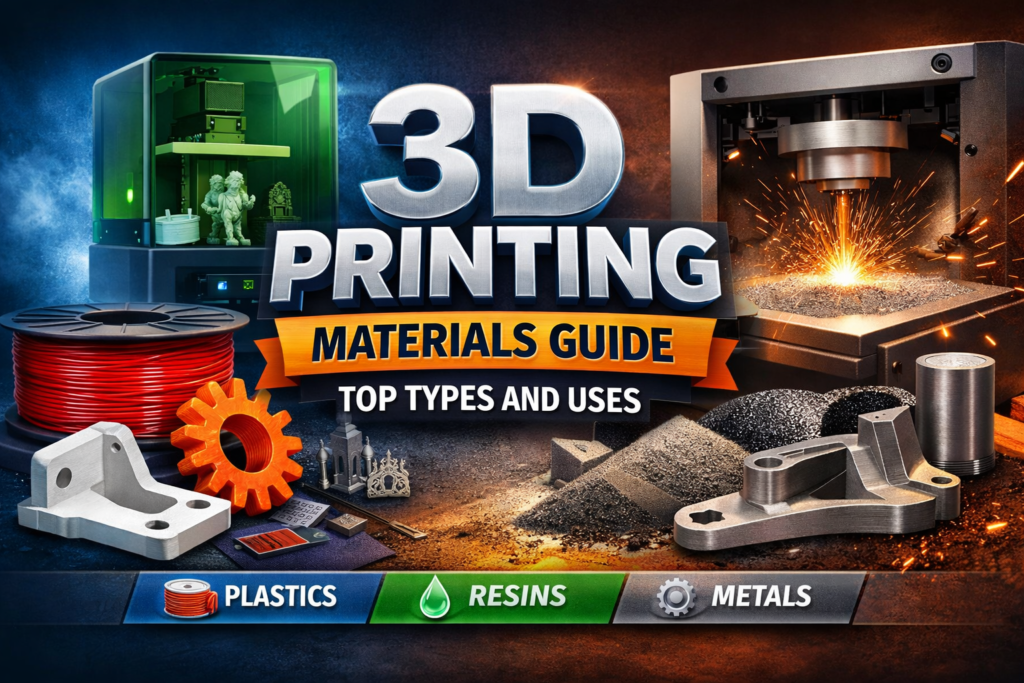

3D printing materials include thermoplastics, photopolymer resins, and metal powders. Choosing the right material depends on your project needs. Consider factors like strength, flexibility, and heat resistance. Polylactic Acid (PLA) works best for beginners. Advanced projects often require carbon fiber composites or stainless steel. This guide helps you select the perfect material for additive manufacturing.
Key Takeaways
- Thermoplastics like PLA and ABS lead the desktop printing market
- Resins offer the greatest detail for small prints
- Industrial applications rely on metal powders and carbon-fiber composites
- Support materials like PVA make complex geometries possible
Who This Is For
This guide helps engineers, hobbyists, and product designers understand additive manufacturing. Here, you’ll find helpful info to choose the best material for your next prototype or production run.
The Foundation of Additive Manufacturing
Your choice of material dictates the success of your project. Early in my engineering career, I printed a mechanical bracket using basic Polylactic Acid (PLA). The part melted under the hood of a car. That failure taught me a crucial lesson about material properties. Match your 3D printing materials to the final environment’s physical demands.
The additive manufacturing industry offers hundreds of options. You can choose basic plastics for simple models. You can select advanced metal powders for aerospace components. Understanding these categories saves you time and money.
Choosing 3D Printing Materials Wisely
You need to check several key factors before starting your print. Consider the mechanical stress the part will endure. Think about exposure to high temperatures or harsh chemicals.
Filament-Based Materials
Fused Deposition Modeling (FDM) uses filament spools to build parts layer by layer. This technology dominates the desktop market.
Polylactic Acid (PLA) serves as the standard starting point. It prints easily and rarely warps. However, it lacks heat resistance. Acrylonitrile Butadiene Styrene (ABS) provides excellent durability and withstands higher temperatures. You need a heated bed and an enclosure to print ABS successfully.
For demanding applications, engineers turn to Nylon 12. This material offers exceptional wear resistance and strength. High Impact Polystyrene (HIPS) and Polyvinyl Alcohol (PVA) act as excellent support materials. PVA dissolves in water. This feature lets you print complex shapes. It does this without leaving rough support marks.
Resin-Based Materials
Stereolithography (SLA) and Digital Light Processing (DLP) printers use liquid photopolymer resin. A UV light source cures the liquid into solid plastic.
Resin printers produce models with perfectly smooth surfaces and tiny details. Jewelers and dentists rely heavily on this technology. You can choose standard resins for visual models. You can also buy tough resins that mimic the properties of ABS. Flexible resins allow you to print parts that bend and compress like rubber.
Metal 3D Printing Materials
Industries use Selective Laser Sintering (SLS) and other advanced techniques to print metal. These machines fuse fine metal powders into solid metal parts.
Stainless steel offers incredible strength and corrosion resistance. Aerospace companies often use titanium and aluminum for lightweight structural components. Metal 3D printing eliminates the need for expensive tooling. This makes it perfect for low-volume production runs.
Advanced Composites
Modern filament makers mix standard plastics with exotic additives. Carbon fiber composites blend chopped carbon strands with nylon or PETG. These materials create high-strength parts that weigh very little. You can find metal-filled filaments. They give plastic parts the weight and feel of real bronze or copper.
Material Comparison Table
| Material Type | Common Examples | Best Used For | Key Characteristic |
| Thermoplastics | PLA, ABS, Nylon 12 | Rapid prototyping, functional parts | Cheap and accessible |
| Photopolymer Resin | Standard, Tough, Castable | Miniatures, jewelry, dental molds | Extreme precision |
| Metal Powders | Stainless steel, Titanium | Aerospace, medical implants | Industrial strength |
| Composites | Carbon fiber filled | Drones, automotive fixtures | High strength-to-weight |
| Support Materials | PVA, HIPS | Complex geometries, overhangs | Dissolvable or breakaway |
Pros and Cons of Common Materials
Polylactic Acid (PLA)
- Pros: Very easy to print, no toxic fumes, cheap
- Cons: Brittle, deforms at low temperatures
Acrylonitrile Butadiene Styrene (ABS)
- Pros: Impact resistant, handles high temperatures
- Cons: Produces harsh fumes, requires a heated enclosure
Photopolymer Resin
- Pros: Unmatched detail, smooth surface finish
- Cons: Messy post-processing, requires chemical washing and UV curing
Metal Powders
- Pros: Creates final end-use parts, massive strength
- Cons: Machines cost hundreds of thousands of dollars; dangerous to handle
Common Mistakes in Material Selection
Beginners often use PLA for outdoor functional parts. The sun will warp these parts within days. Always use UV-resistant materials like ASA or PETG for outdoor use.
Another frequent mistake involves ignoring moisture. Materials like Nylon 11 and Nylon 12 absorb water from the air rapidly. Wet filament causes poor layer adhesion and weak prints. You must dry your materials in an oven or a dedicated filament dryer before use.
Sustainability in 3D Printing
The 3D printing industry faces pressure to reduce waste. Failed prints and disposable support structures generate massive amounts of plastic trash.
You can improve your environmental footprint by choosing eco-friendly options. PLA comes from fermented plant starch. Many vendors now sell recycled PETG made from old water bottles. You can optimize your slicing profiles. This helps use less infill and fewer support materials. This approach saves plastic and reduces print times.
Frequently Asked Questions
What is the strongest 3D printing material?
Carbon fiber composites and metal powders, such as stainless steel, provide the best strength for industrial uses.
Can you mix different materials in one print?
Yes. Dual-extrusion printers let you print a rigid plastic with a flexible material or a water-soluble support.
How do I store my 3D printing filaments?
Store your filament spools in airtight containers with desiccant packets. This prevents moisture absorption and keeps prints clean.
Is resin printing toxic?
Liquid photopolymer resin can irritate the skin and respiratory system. Always wear gloves and work in a well-ventilated space.
Conclusion: Your Gateway to Material Mastery
Selecting the right 3D printing materials determines the success of your entire project. Start simple with PLA to master your printer settings. As your skills grow, experiment with tough nylons, detailed resins, and high-strength composites. Keep your specific project requirements in mind, and you will consistently produce parts that perform exactly as intended.